TL;DR
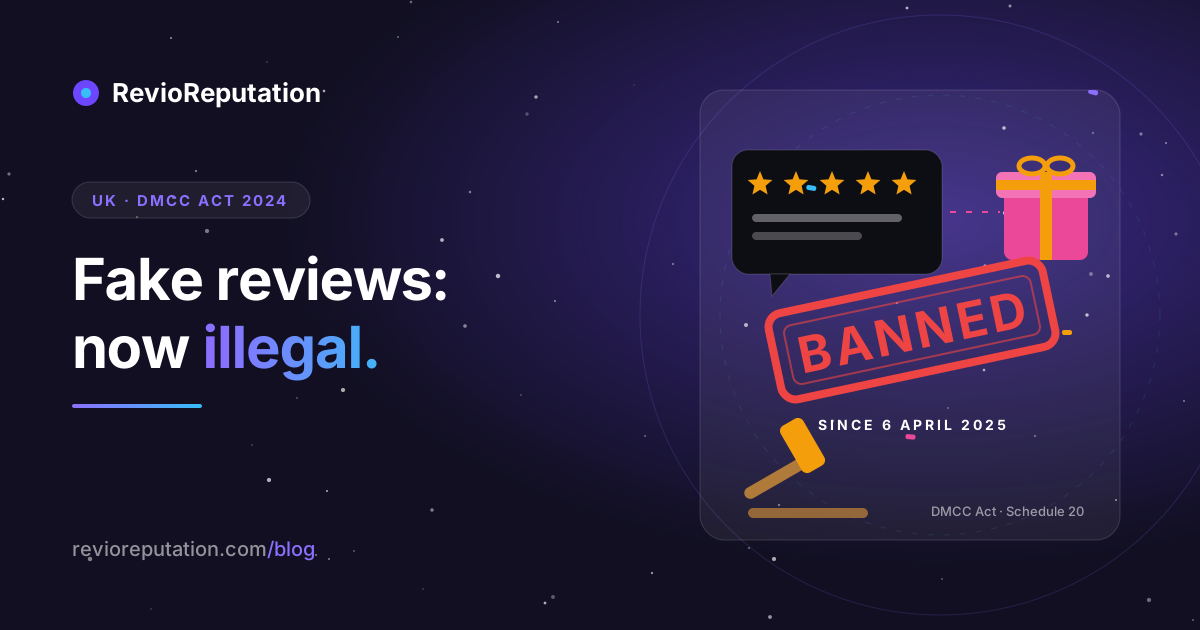
Since 6 April 2025, Schedule 20 of the Digital Markets, Competition and Consumers Act 2024 lists three review practices as unfair in all circumstances: submitting or commissioning a fake review, submitting or commissioning a review that hides the fact it was incentivised, and publishing reviews in a misleading way. The Competition and Markets Authority can now fine a business directly, up to 300,000 pounds or 10% of turnover, whichever is higher. The CMA's guidance says that offering an existing customer a free or discounted product for a five-star review is commissioning a fake review. Google's rules go further and ban any incentive at all. The way to ask that satisfies both is the same for a garage in Leeds and a bistro in Bath: ask everyone, in the same way, at the end, with nothing attached.
What changed, in plain terms
Before April 2025, a fake review in the UK was a breach of the Consumer Protection from Unfair Trading Regulations, and enforcing it meant the CMA going to court. That rarely happened to a business with one location.
The DMCC Act did two things. It wrote reviews into the banned list by name, so there is no longer an argument about whether a given practice is "misleading enough". And it gave the CMA the power to decide a breach itself and impose the fine, without a court. Section 182 sets the ceiling: a fixed amount of up to 300,000 pounds or, if higher, 10% of turnover. For a small business the first number is the one that matters, and it is still more than the business is worth.
The CMA published its guidance, CMA208, on 4 April 2025, and said it would spend the first three months helping businesses comply before it started enforcing. That window closed in July 2025. The guidance is written for platforms and for businesses that collect reviews, and it is the document a CMA case officer will have open.
The three banned practices
Schedule 20, paragraph 13, in its own words, bans:
- "Submitting, or commissioning another person to submit or write, a fake consumer review, or a consumer review that conceals the fact it has been incentivised."
- "Publishing consumer reviews, or consumer review information, in a misleading way."
- Publishing reviews without taking "reasonable and proportionate steps" to remove and prevent fake ones.
Two definitions make the first one bite. A fake review is one that "purports to be, but is not, based on a person's genuine experience". And "commissioning includes incentivising by any means". So a review written by your cousin who has never had their car serviced by you is fake. And a review from a real customer who was given a free MOT for it is an incentivised review, and it is banned unless the review says so.
The third practice is aimed at platforms and at businesses that run their own review pages. If you only have a Google profile, it is Google's job to take reasonable steps. If you also publish reviews on your own website, read the section on widgets below.
What the CMA says about incentives
This is the part that changes daily habits, so here is the guidance itself rather than a summary.
The CMA does not ban incentivised reviews outright. Paragraph 3.4 of CMA208 says publishing an incentivised review "is not prohibited per se". But paragraph 3.5 says that where an incentivised review is posted, it "must be clearly identifiable as incentivised", and that "usually, it will be necessary for the reviewer at least to label the review prominently as incentivised, namely, as an advert". A label that is ambiguous, or placed where a reader will not see it, does not count.
Then the guidance gives an example of banned commissioning: "Offering an existing customer a free or discounted product in exchange for a five-star review." Note the words "five-star". The problem is not the discount alone. It is the discount tied to the rating.
And paragraph 2.10 lists what counts as an incentive: money, commissions, discounts, vouchers, and other benefits. A free dessert is a benefit.
So the UK position is: an incentive is allowed only if it is not tied to the rating and the review is labelled as an advert. Which brings us to the second rulebook.
Google's rules are stricter, and they apply to you too
Google's content policy for Maps, which your Business Profile is subject to, says a business must not "offer incentives, such as payment, discounts, free goods and/or services, in exchange for posting any review or revision or removal of a negative review". Any review. Labelled or not. It also says a business must not "discourage or prohibit negative reviews, or selectively solicit positive reviews from customers", and should not "require or pressure users to leave ratings or write reviews while on the premises".
Put the two rulebooks together and the combined rule is short. On Google, no incentive, ever. No asking only the happy customers. No standing over someone while they type. A breach of Google's policy gets reviews removed, or a profile suspended, and a suspended Google profile closes a garage faster than any CMA letter.
This is where "review gating" apps died. The ones that sent a text saying "how was it?" and routed the 5s to Google and the 1s to a private form were selective solicitation under Google's rules all along, and under paragraph 13(2) they now publish reviews in a misleading way. If you have one, switch it off. I wrote about what replaced gating in May, and the answer has not changed.
The ask that is legal under both
Ask everyone. Ask them in the same way. Ask at the end of the visit, when the work is done and the bill is paid. Attach nothing.
For a garage, that is the moment the keys come back. For a salon, the mirror check. For a restaurant, the card machine. The customer has their phone in hand, the experience is complete, and they have a minute. A QR code on the counter, the key tag or the bill folder, with the words "Leave us a Google review" and nothing else, is the whole method.
The code must open the review form itself. Google now gives every Business Profile a link and a QR image for this: in your profile, go to Read reviews, then Get more reviews, and copy the link or save the QR. Google's own help pages say the code can go on receipts, in thank-you emails and on a sign in the shop, and that asking customers "to visit a Google link or scan a QR code" is fine. What the same pages say is not fine is offering "free or discounted goods or services" for it.
If you do not want to log in to Business Profile for it, ReviewQR makes the code from your business name and city, without an account. It opens the same form.
A few things people ask at this point:
Can I remind people by text or email? Yes. Everyone, same message, no reward. A single reminder a day after the visit is normal. Three is harassment.
Can I give a discount for "feedback" rather than a review? If the feedback is private, to you, yes. If you then ask them to paste it onto Google, you have incentivised a review, and it is banned on Google regardless of the label.
Can I ask the customer who just thanked me, and not the one who complained? No. That is selective solicitation. Ask both. The one who complained will usually not write anything, and if they do, you reply to it like an adult.
What about my regulars, or my staff's families? A review from an employee or a relative is a conflict of interest under Google's rules and is not "genuine experience" in the sense the Act means. Do not ask them.
If you show reviews on your own website
Paragraph 13(2) bans publishing reviews "in a misleading way". The CMA's worked examples are about platforms, but the words cover a garage's homepage too.
The practical test is whether the page gives a true picture. Five hand-picked five-star quotes under "What our customers say", with no overall rating anywhere, is a selection presented as the whole. The same five quotes next to "4.4 from 212 reviews on Google", with a link to the profile, is a selection presented as a selection. The second one is fine. The first one is the thing the paragraph describes.
A widget that pulls the rating and count from Google automatically keeps you on the right side of this without thinking about it, because the number updates when the reviews do. ReviewQR's widget shows the real aggregate with every layout; put a link to your Google profile next to it. If you build your own, make the number real and keep it current.
The two-week plan
- Walk the premises and take down every sign, card or script that offers anything for a review. Today.
- If you use a text or email tool that filters by rating before sending people to Google, switch the filter off or switch the tool off.
- Get the official review link from Business Profile and put a QR code at the one point where every customer stands still at the end of a visit.
- Brief the staff in one sentence: we ask everyone, the same way, and we never offer anything for it.
- If your website shows reviews, put the real Google rating and count next to them with a link, or use a widget that does.
- Reply to every review, including the bad ones, within a few days. Offering a reviewer anything to change or remove a negative review is banned by Google's policy in the same sentence that bans paying for new ones. Replying to explain and apologise is not.
The Act is at legislation.gov.uk and the guidance is at gov.uk, CMA208, both read on 10 October 2026. Google's policy is on its prohibited and restricted content page and the review link instructions are on the Business Profile help pages for getting more reviews and creating the link or QR code. None of it takes more than an hour to read, and the hour is cheaper than the letter.
New blog posts. No spam.
Get the next reputation playbook delivered when it drops.