TL;DR
There are two ways to get a review off your Google profile. The first is the report button inside Business Profile, which asks Google whether the review breaks Google's own content rules. It is quick to file, and it fails on the most common case: a one-star review from someone who was never your customer, written in polite language. The second is a notice under the EU Digital Services Act, which asks Google whether the review is illegal under EU or national law. Since February 2024 Google has to run that process for every person in the EU, has to tell you what it decided and why, and has to give you a complaint route if it says no. Almost no small business uses it. This post is about using it well.
First, which kind of review do you have
Before filing anything, sort the review into one of three boxes. The route depends on the box.
Box one: it breaks Google's rules on its face. Profanity, a phone number, a link, a threat, a review of a different business, a review that is obviously copied across ten profiles. Use the report button. This is what it is for, and it usually works within a week.
Box two: it is false, and you can show it. The reviewer describes a visit that did not happen, a dish you do not serve, a mechanic you do not employ. Or the account has reviewed every competitor in your street with five stars and you with one. Google's rules call this "fake engagement" and forbid it, so the report button is still the first step. But if Google does not act, this box is where the DSA route earns its place, because a fake review is also illegal under EU consumer law.
Box three: it is real and you do not like it. A customer came, had a bad evening, said so. There is no route for this one, and trying to file one damages you: Google's rules ban businesses from discouraging negative reviews, and a public reply that argues with the reviewer loses the next ten readers. Reply briefly, fix what you can, move on. I wrote twelve replies that work for exactly this situation.
Most owners put every bad review in box two. Be honest with yourself. The DSA route is only worth the effort for a review you can show is false.
Route one: the report button, done properly
In Business Profile, open Read reviews, click the flag next to the review, choose the reason, submit. Google's own help page says evaluation "typically takes several days". If Google says no, you get one appeal, and an appeal can be escalated to a human, after which you receive the decision by email. All of this is in Google's page on reporting inappropriate reviews, and the reviews management tool shows the status of every report you have filed.
Two things make the difference between a report that works and one that does not.
Pick the right reason. "Off topic" and "Conflict of interest" are read differently from "Spam". A review from a competitor's employee is a conflict of interest. A review that describes a different business is off topic. Say which, and say why in the box if there is one.
Use the one appeal for evidence, not for emotion. The appeal is the only moment a person is likely to read your words. Give them the one fact that settles it: "We opened on 3 March 2026. The review describes a visit in January." That is enough. A paragraph about your reputation is not.
Route two: the DSA notice
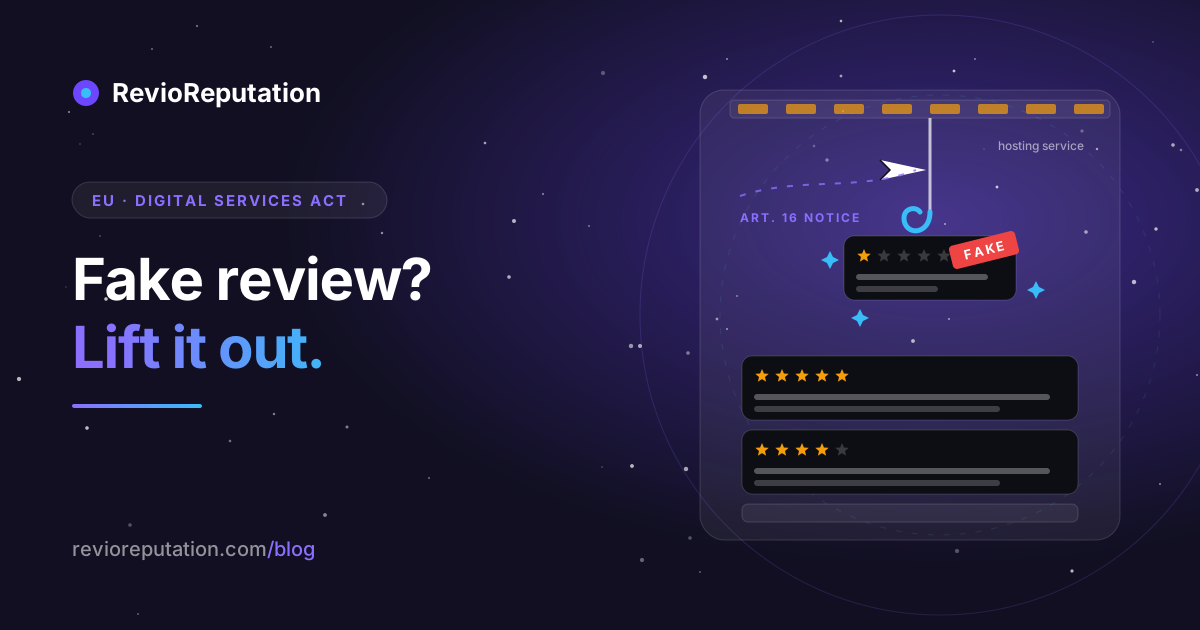
The Digital Services Act, Regulation (EU) 2022/2065, has applied in full since 17 February 2024. Article 16 obliges every hosting service, Google Maps included, to run a mechanism that lets any person notify it of content they consider illegal. Article 16 also says what a notice must contain, and that is the part worth reading twice, because a notice that has all four elements gives Google "actual knowledge" of the content. From that moment Google is responsible for the decision it makes.
The four elements:
- An explanation of why you consider the content illegal, with enough substance that someone who knows nothing about your business can follow it.
- The exact location of the content. For a review, that is the share link of the review itself, not your profile.
- Your name and email address.
- A statement that you believe, in good faith, that the information in the notice is accurate and complete.
Then Article 17 requires Google to give a statement of reasons for whatever it decides, and Article 20 gives you access to an internal complaint system for at least six months after that decision. If Google still says no, Article 21 lets you take the dispute to a certified out-of-court settlement body. For a one-location business, the complaint under Article 20 is usually as far as you need to go. The regulation itself is on EUR-Lex; Articles 16 to 21 are the ones to read.
Where to file: Google has no form labelled "DSA" for Maps reviews. The legal route is Google's Report Content for Legal Reasons page, which leads to a troubleshooter where you pick Google Maps and then local listings. Google's own page asks for the specific URL, what on the page is unlawful and why, and whatever background is needed to evaluate the request. That is Article 16 in Google's words. Google's Maps policy page on legal removals confirms this is the path for content "in violation of local law", and its EU redress options page describes the complaint and dispute-settlement steps that follow a decision.
What "illegal" means here, and how to say it
This is the part owners get wrong, and it is why their notices fail. "It is unfair" is not a legal ground. "It is damaging my business" is not a legal ground. Two things are.
The first is consumer law. Since 28 May 2022 the Unfair Commercial Practices Directive, as amended by Directive (EU) 2019/2161, lists as a banned practice in all circumstances "submitting or commissioning another legal or natural person to submit false consumer reviews or endorsements, or misrepresenting consumer reviews or social endorsements, in order to promote products". That is Annex I, point 23c. A fake review of your business is a banned commercial practice in every member state, and every member state wrote it into national law under its own number. Cite the national one as well as the directive; the person reading your notice may only know one of them.
| Country | Where point 23c lives | In force |
|---|---|---|
| Spain | Ley 3/1991 de Competencia Desleal, art. 27.8 | 28 May 2022 |
| France | Code de la consommation, art. L121-4, 28° | 28 May 2022 |
| Germany | UWG, Anhang Nr. 23c | 28 May 2022 |
| Portugal | Decreto-Lei 57/2008, art. 8, al. dd) | 28 May 2022 |
| Poland | Ustawa o przeciwdziałaniu nieuczciwym praktykom rynkowym, art. 7 pkt 26 | 1 January 2023 |
| Czech Republic | Zákon o ochraně spotřebitele, příloha 1, písm. z) | 6 January 2023 |
| United Kingdom | DMCC Act 2024, Schedule 20, para 13 | 6 April 2025 |
If you can show the account belongs to a competitor or reviews competitors in a pattern, say that too.
The second is defamation or the national equivalent. A review that states a false fact ("they served us food that gave three of us food poisoning") can be unlawful under the civil code of your country when the fact is false. An opinion ("the worst meal of my life") cannot. If your review states a checkable fact that is false, say which fact, and say why it is false, with the evidence attached.
Write the notice like this, in your own words:
The review at [link] states that the reviewer visited on [date] and that [fact]. We have no record of this person as a customer. [Fact] is false because [evidence]. This review is an unfair commercial practice under Directive 2005/29/EC, Annex I, point 23c, as amended by Directive (EU) 2019/2161, and under [your national law]. I ask that it be removed. I confirm in good faith that this notice is accurate and complete. [Name, email, business, address.]
Four sentences of substance. Attach the screenshots. Keep a copy with the date you sent it.
Evidence that works, and evidence that does not
Works:
- Your booking or point-of-sale record for the day in question, with the name absent.
- The reviewer's public profile showing one-star reviews across your competitors, or reviews in five cities on the same day.
- A fact in the review that cannot be true: a dish, a service, an employee, a room, a date before you opened.
- Identical text appearing on another business's profile.
Does not work:
- Your overall rating. Nobody at Google weighs a 4.7 against one review.
- Other customers' praise.
- The reviewer's tone.
- A long account of what the review has cost you.
The notice is read by someone deciding one question: does this specific content break a specific rule. Give them that and nothing else.
While you wait
Google's "several days" can become weeks on the DSA route, and the review is live the whole time. Three things, in order.
Reply publicly, once, in two sentences. Something like: "We have no record of a visit under this name and have asked Google to review this entry. If you were a guest, please write to us at [email] so we can look into it." Readers understand what that means. It also puts a dated statement on the record, which helps if the dispute goes further.
Keep collecting real reviews. One fake one-star in a profile that gains three honest reviews a week stops mattering in a month. In a profile that gains three a year it is the headline. The fastest way to keep the rate up is a QR code at the moment a happy customer is still at the table; the restaurant playbook covers placements.
Set up an alert so you find the next one in an hour, not in a month. Most fake reviews arrive in small batches, and the batch is itself evidence. If your reviews only come to you when you remember to check Maps, you will miss the pattern. RevioReputation connects to your Business Profile and sends the new review to your phone, with a suggested reply, the moment it lands.
When to involve a lawyer
A single fake review: do the two routes yourself. The cost of a lawyer's letter is more than the review is worth, and Google answers notices from owners.
A campaign, meaning several fake reviews over days or weeks from accounts with a pattern, or a review that names an employee or makes a criminal accusation: get a lawyer the same week. They will file the DSA notice with your evidence, and they can go to court for an injunction at the same time, which Google treats differently from a notice. A court order is the one document that removes a review on a timetable you control.
The short version
- Sort the review: rule-breaking, false, or honest. Only the first two have a route.
- File the report button first. Choose the right reason. Save your appeal for one hard fact.
- If Google says no and the review is false, file a DSA notice with the four Article 16 elements and a legal ground: Annex I point 23c of the Unfair Commercial Practices Directive, your national transposition, or defamation for a false statement of fact.
- Reply publicly once, in two sentences, with your contact address.
- Keep collecting real reviews. Rate beats count.
- Get alerts, so the next one is found in an hour and the pattern is caught.
If you want the alerts and the suggested replies without building anything, that is what RevioReputation does, and the PRO trial is seven days with no card.
New blog posts. No spam.
Get the next reputation playbook delivered when it drops.