TL;DR
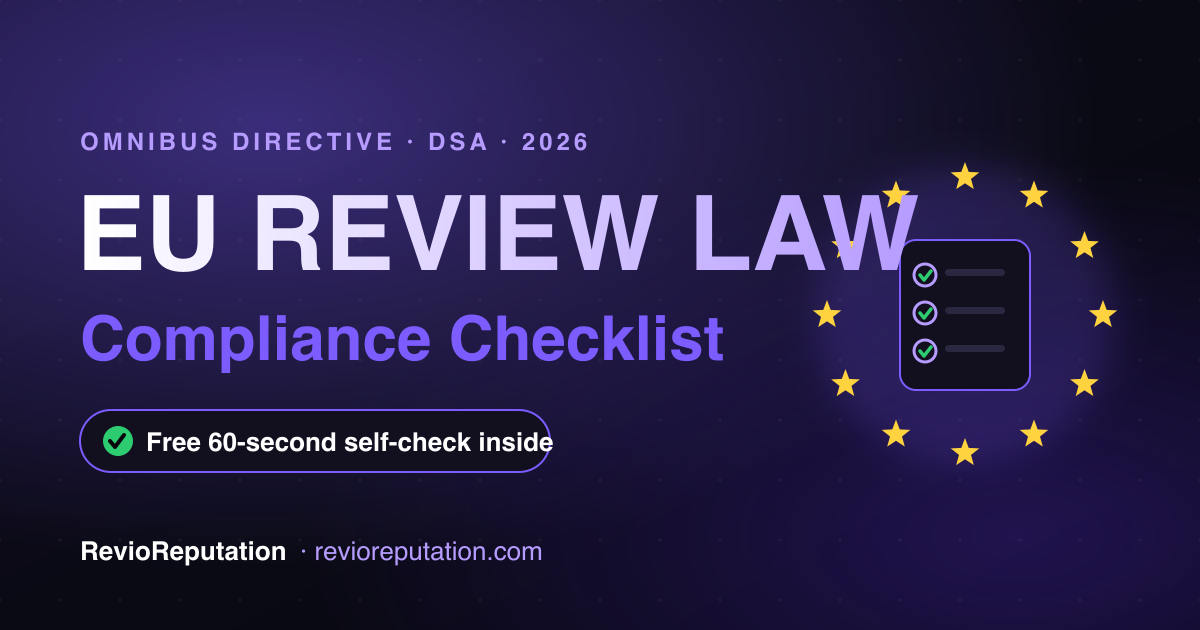
Since the Omnibus Directive (EU) 2019/2161 took full effect, how you collect, verify, display and respond to reviews is regulated across every EU member state — and enforcement in 2026 has teeth (fines reach up to 4% of annual turnover for cross-border infringements). Most small businesses are non-compliant without knowing it, usually through review gating (only asking happy customers), undisclosed incentives, or missing a verification statement. None of it is hard to fix. Below is the full checklist, the rule behind each item, and a free 60-second compliance checker to see your risk instantly.
Educational guide, not legal advice. For a binding opinion, consult a qualified lawyer in your country. For the deeper "why it's now a liability" story, read Fake Reviews Are Now a Legal Liability in the EU.
Why this matters now (and why "we've always done it this way" is the risk)
For years, the local-marketing playbook quietly encouraged practices that are now explicitly unlawful in the EU: send a quick survey, route the 5-star folks to Google, and keep the unhappy ones offline. That "smart funnel" is exactly what regulators mean by an unfair commercial practice. The rules didn't just appear — they've been in force since 2022 — but 2026 is when consumer authorities, competitors, and platforms under the Digital Services Act started acting on them.
The good news: compliance is not a competitive disadvantage. Businesses that collect reviews honestly and transparently end up with more reviews, a more believable rating, and stronger local ranking — because Google rewards volume and recency, not a suspiciously perfect average.
The checklist
1. Collection — ask everyone, the same way
- ✅ Invite every customer to review, with the same message and timing.
- ❌ Don't pre-screen by sentiment ("rate us first, and only happy customers go to Google"). That's review gating — an unfair practice under the Omnibus Directive.
- Why: selectively soliciting positive reviews makes your overall rating misleading, which is prohibited.
2. Incentives — only with disclosure, never rating-conditioned
- ✅ If you reward reviews (discount, prize draw), make it unconditional on the rating and clearly disclosed next to the reviews.
- ❌ No "leave us 5 stars for 10% off." Undisclosed or rating-conditioned incentives are a banned practice.
3. Verification — say whether and how you check reviewers are real
- ✅ Publish a short statement describing how you ensure reviews come from actual customers (e.g. tied to a real transaction or booking).
- Why: the Omnibus Directive specifically requires traders who give access to reviews to state whether and how they guarantee authenticity.
4. Negatives — respond, never suppress
- ✅ Reply professionally to genuine negative reviews.
- ❌ Don't hide or delete genuine negatives. You may report reviews that break platform policy (fake, abusive, off-topic) — that's different from silencing criticism.
5. Process — document who responds, how fast, and in what tone
- ✅ Keep a simple written response policy and hit a consistent response time.
- Why: it demonstrates good-faith handling and speeds your reaction to problem reviews — and response speed is itself a local-ranking signal.
Run the free check (60 seconds)
Rather than guess, answer five questions and get a scored risk report with the exact fixes for your situation:
→ EU Review Law Compliance Checker — free, no signup.
How to stay compliant without it becoming a second job
The checklist is simple; doing it consistently across every location and every review is where teams slip. That's the part software should carry:
- One inbox for every review across Google, Facebook, Instagram, LinkedIn and TripAdvisor, so nothing is quietly cherry-picked.
- The same review invitation to every customer — no sentiment routing.
- AI-assisted responses in seconds so negatives get a timely, professional reply instead of being buried.
- A clean trail of how reviews were collected and answered.
That's exactly what RevioReputation is built to do — enterprise-grade review handling at SMB pricing (from $59/mo), so compliance is the default rather than a chore.
FAQ
Is review gating illegal in the EU? Selectively soliciting or publishing only positive reviews can make your rating misleading, which is treated as an unfair commercial practice under the Omnibus Directive. Invite every customer the same way instead.
Can I offer a discount for a review? Only with clear, prominent disclosure, and the reward must not depend on giving a positive rating. Undisclosed incentivised reviews are a banned practice.
Do I have to keep negative reviews? You should not hide or delete genuine negatives — that distorts the overall picture. Report only reviews that break platform rules, and respond to the rest professionally.
What are the penalties? For widespread cross-border infringements, fines can reach up to 4% of annual turnover; national authorities also apply their own penalties. Competitors can bring unfair-competition claims, and DSA-covered platforms increasingly act on manipulation.
Where do I start today? Run the free compliance checker, fix any flagged items, and switch to a single honest collection flow for every customer.
New blog posts. No spam.
Get the next reputation playbook delivered when it drops.