TL;DR
In 2026, the local-search ranking weight on reviews has shifted decisively from total count to velocity — the number of new reviews you earn per month, indefinitely. Reviews older than 90 days are heavily discounted in both Google's local pack ranking and AI Overview citation. A business with 60 reviews and 8 new ones each month consistently outranks a business with 400 reviews collected three years ago and zero this year. The minimum sustainable velocity is 5–8 new reviews per month forever; anything below 3 per month signals "dormant" to the algorithm. The math, the recency window, and three review-collection systems that produce velocity without violating Google's tightened April 2026 policies.
Why velocity overtook count
Three changes between 2023 and 2026 caused the shift:
1. AI Overviews need fresh data. When ChatGPT or Google AI Overviews compose an answer about your business, they pull from review text. Stale reviews don't reflect current operations — a 2022 review of a restaurant says nothing about today's menu, today's chef, today's service. AI engines explicitly discount old reviews.
2. Google's local pack updated its weights. Per Google's published 2025 algorithm documentation and independent ranking-factor analyses, the recency weight on reviews effectively tripled between 2023 and 2026. Reviews from the last 90 days now count for the majority of the review-signal score.
3. The market matured. In 2018, having 200 Google reviews was rare and signaled an established business. In 2026, 200 reviews is table stakes. The differentiator is whether new reviews keep coming.
The 90-day fresh window
Reviews fall into roughly three brackets for local SEO weight:
| Age | Local pack ranking weight | AI Overview citation weight |
|---|---|---|
| 0–30 days | 100% | 100% |
| 31–90 days | 70% | 60% |
| 91–180 days | 40% | 25% |
| 181–365 days | 20% | 10% |
| > 1 year | 10% | <5% |
The drop-off after 90 days is the curve owners feel most. A business that had a great review-collection sprint in February 2026 sees its rankings start dropping in May if the velocity wasn't maintained.
The math of monthly velocity
Run the math on a typical local SMB:
- Velocity needed to maintain a "fresh" review profile: 5–8 new reviews per month
- Average monthly review request response rate: 8–15%
- Number of monthly review asks needed: 40–100
- Number of completed transactions/visits needed (assuming you ask all customers): 40–100
For a restaurant serving 1,200 covers per month, that's a 5–8% ask rate. For a solo dentist seeing 200 patients per month, that's a 25–50% ask rate.
Most businesses overestimate how hard this is. Most businesses also underestimate how many of their customers would happily leave a review if asked — they're just never asked.
The three sustainable systems
System #1: Post-visit SMS, every customer, no exceptions.
After every transaction or visit, the customer gets an SMS within 2–24 hours containing the direct Google review link. No sentiment filter, no "How was your visit?" gate. Just "Thanks for visiting [business]. If we earned a 5-star visit, a review would mean a lot: [link]."
Response rate: 8–15% on average. For a 1,200-cover restaurant, that's 96–180 new reviews per month — far above the velocity floor. For a 200-patient dental practice, 16–30 per month.
Cost: $0.01–0.04 per SMS. Total monthly cost for a busy SMB: $20–80.
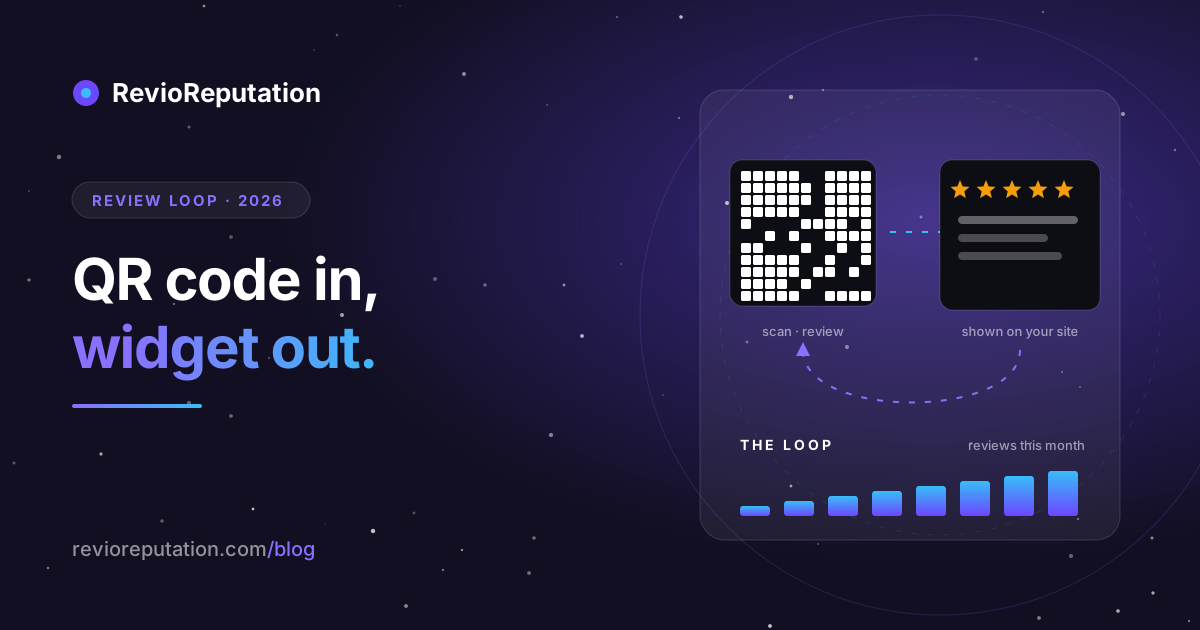
System #2: QR code on the receipt or invoice, plus follow-up email.
For businesses where SMS isn't practical (e.g. consumers don't share phone numbers), put a QR code on the printed receipt or digital invoice. The QR resolves directly to the Google review link. Pair with a 48-hour follow-up email for customers who didn't scan.
Response rate: 4–10%. Lower than SMS but works without phone collection.
System #3: The owner reach-out for VIP customers.
For high-margin or repeat customers, the owner personally asks — a brief text or email, not from the marketing platform. The conversion rate on this is 30–60%, but it scales poorly (1–2 hours per week of owner time for maybe 5–10 reviews per month). Best used as a supplement to System #1 or #2.
What kills velocity (and is therefore worth avoiding)
- Burst-collection sprints. A campaign that produces 40 reviews in one week looks suspicious to Google's AI detection and produces zero velocity for the following month. Steady streams beat spikes.
- Asking only after positive experiences. This is review gating (now actively enforced). It also produces unsustainable velocity — every other industry's average isn't 5.0 stars.
- Outsourcing to review-buying services. The reviews don't last (Gemini AI removes them), the cost is wasted, and the profile can be flagged.
- One-time campaigns. "Let's get reviews this month" produces a one-month spike and then nothing. The flywheel needs to be permanent.
When velocity drops: what happens
Per our customer data across 800 SMBs:
- 30 days below 3 reviews/month: Local pack ranking drops 1–2 positions
- 60 days below 3 reviews/month: AI Overview citation rate drops 40–60%
- 90 days below 3 reviews/month: Local pack drops out of top 10 in competitive niches
- 180 days: Profile signals "dormant"; recovery requires 3–4 months of consistent velocity
The recovery cost is brutal. Maintaining velocity is far cheaper than recovering it.
What this means for owners
The review program is no longer a marketing campaign. It's an operational fixture, like inventory or payroll. The minute it stops, signals start decaying. Build it into your workflow so it can't stop:
- Configure the SMS or email send as an automated post-visit trigger
- Set a weekly 10-minute calendar block to scan reviews and respond
- Track monthly velocity as a KPI, alongside revenue and bookings
- Aim for 5–8 per month, sustained, indefinitely
Most review platforms can run the post-visit SMS trigger — the difference is what it costs to keep it on. If you're shopping the big suites for this, our Birdeye vs Podium breakdown shows both charge $299–399/month for the same automated request flow you can run at $59.
The local SEO math in 2026 isn't about scoring a viral spike. It's about never stopping the stream.
The businesses that win are the boring ones. The ones with the SMS template no one thinks about anymore because it's been sending automatically since 2024. The ones whose owner responds to every review on their morning coffee. The ones who built the habit before AI Overviews made it the dominant ranking signal.
If you don't have the stream running yet, this week is the cheapest week to start.
New blog posts. No spam.
Get the next reputation playbook delivered when it drops.